Tuesday, January 6, 2015

Tiny Teff Grains Deliver Big on Nutrition

Tiny Teff Grains Deliver Big on NutritionTiny Teff Grains Deliver Big on Nutrition


32


I first tasted the delicious, gluten free grain known as teff shortly after my husband and I were married. We met after work at an Ethiopian restaurant that we’d been wanting to try for quite some time. My husband was born and lived his early years in Uganda, and he was eager to introduce me to some of the flavors of his home continent.
I was immediately enthralled and delighted by the basket of soft, spongy flatbread that was brought to our table to use as an edible utensil for our meat stew.
Never having experienced the light, slightly nutty flavor of teff before, I asked the waitress about the bread’s origins. She proudly explained that injera is a traditional fermented bread made from teff flour that is a staple in Ethiopia.

Teff Consumed for Thousands of Years
According to the Whole Grains Council, teff is thought to have gotten its start as part of the human diet around 4000 B.C. in what is today the country of Ethiopia.  Ethiopians obtain approximately two-thirds of their dietary protein from teff. The ultra tiny grain, smaller even than a chia seed, is what Ethiopia’s famously competitive long distance runners credit for their energy and stamina.
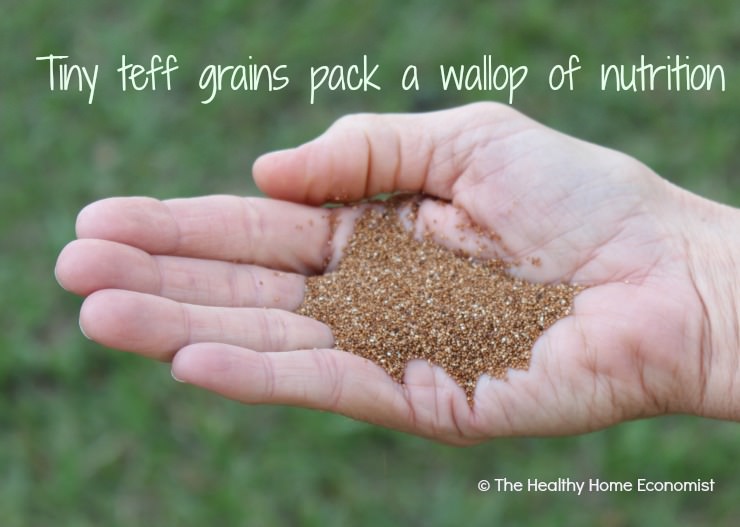
The tiny size of the teff grain, which can appear dark reddish brown to yellowish brown to ivory, made it the ideal food for the semi-nomadic life common throughout Ethiopian history. Only a handful of the seed as shown in the picture above will sow an average size field no matter whether water-logged or dry, thus making teff a dependable staple no matter what the environmental conditions.
In addition to climate, teff will grow at a variety of altitudes – from sea level to nearly 10,000 feet (300 meters). The incredible versatility and hardiness of teff has resulted in its cultivation in diverse areas around the world such as mountainous Idaho, dry Australia, and low lying, wet areas of the Netherlands and India.
Teff a Nutritional Powerhouse
Despite its tiny size, teff leads all other grains, gluten free or not, in calcium by a wide margin. It also has high levels of magnesium, potassium, zinc, copper, manganese, choline, Vitamin B3 (niacin), Vitamin B6, Thiamin, Pantothenic Acid, and Riboflavin.
Teff’s biggest health benefit, however, may very well be in its unique type of starch.
Teff is high in resistant starch, a special type of dietary fiber only recently getting much attention from the research community. Resistant starch benefits blood sugar management, weight control, and overall health of the large intestine.
Up to 40% of the carbohydrates in teff are composed of resistant starches!
The only downside of teff in my experience cooking and baking with it is that it is so tiny that most grain mills can’t even grind it into flour! Unless you have a special grain mill that can manage teff’s ultra miniscule size, it is best eaten in whole form as a delicious, mild, slightly nutty tasting porridge or added to soups and stews to thicken and add texture.
Teff Porridge (a Great Place to Start)
Porridge made from teff is my personal favorite beating out even that old stand-by – oatmeal. It is easy to make and a great place to start with teff in your kitchen if you don’t currently have a grain grinder that permits easy grinding of fresh teff flour. I don’t recommend purchasing teff flour, as much of the nutritional benefit is lost within a few days of grinding.
Ingredients
1 cup teff grains (where to find)
3 cups filtered water
1 Tbl butter
1/4 tsp ground cloves (optional)
1 tsp lemon juice or apple cider vinegar (optional)
1/4 tsp sea salt
Instructions
Sprouted Teff:  Teff only requires 36 hours or less to sprout – the shortest time of any grain. This is likely due to low amounts of mineral blocking phytic acid, although I was unable to find definite numbers on this to confirm.
If you would like to sprout your teff grains before cooking to add additional vitamins and render it even more digestible, follow these steps before cooking:
  • Place 1 cup of teff grains in a glass sprouting jar (I like these).
  • Rinse the teff grains several times with filtered water until thoroughly wet. Drain completely.
  • Lay the sprouting jar on its side to allow the circulation of air.
  • Every few hours, rinse again and reset the jar on its side.
  • Anywhere from a few hours to at most 36 hours (depending on the time of year and warmth/humidity in your home), the tiniest of buds will appear (they are very hard to see) and the sprouted teff grains will be ready for cooking (see toasting step below).
Toasted Teff Porridge:  Heat a large saucepan over medium heat, add sprouted (or unsprouted) teff grains and toast, stirring frequently until the grains begin to pop which takes just a few minutes.
Add the water, sea salt, butter and optional cloves.
Bring to a boil, cover and cook for 8-10 minutes stirring occasionally.
Soaked Teff Porridge: You also have the option to make soaked teff porridge if desired.  Simply place the teff grains, filtered water, and lemon juice (or ACV) in a pot, mix well and cover overnight.  In the morning, add sea salt, butter and optional cloves and cook for about 10 minutes until the water is absorbed and the porridge is of desired consistency (very similar to Cream of Wheat).
Whether you choose to make sprouted, toasted or soaked teff porridge, serve with your favorite whole sweetener (I prefer raw honey) and/or fruits and nuts of choice.
I have just finished a bowl of soaked teff porridge as I finish typing this.  I hope you enjoy this delicious, warm, and satisfying way to mix it up for breakfast!
Sarah, The Healthy Home Economist

Sources and More Information

- See more at: http://www.thehealthyhomeeconomist.com/gluten-free-teff-high-in-nutrition/#sthash.jhTDoM2b.dpuf

Tiny Teff Grains Deliver Big on Nutrition | The Healthy Home Economist | The Healthy Home Economist

Tiny Teff Grains Deliver Big on Nutrition | The Healthy Home Economist | The Healthy Home Economist

Have More Sex – It May Help Prevent Breast Cancer

on January 6, 2015
Sex – some women love it and some women can go without it. Years of research have demonstrated that people who engage in regular sexual intercourse generally have a longer and healthier life. To be even more specific, it is possible that regular sex may be one of the “therapies” that helps prevent Breast Cancer.
Essential # 3 of The 7 Essentials™ is to Balance Your Energy. Hormone balancing falls under that category. Hormones are powerful chemical messengers that can affect your Immune System, your metabolism, your mood, your mental health and several other body functions.
During sexual intercourse and orgasm, specific “happy” hormones such as Oxytocin and DHEA are released. These hormones may help to keep breasts cancer-free and here is why:

For many women, the ability to enjoy sex appears to be quite limited after a cancer diagnosis. Often women have to deal with the side effects of traditional treatments and the changes in their body. Surgery may have resulted in the loss of part of a breast, a whole breast or both breasts. For many women, their breasts are an important part of their sexual identity.
Chemotherapy can cause the ovaries to shut down and bring on early menopause. Vaginal dryness, painful intercourse, mood swings and hot flashes often accompany this chemical menopause.  Often women will actually mourn or grieve the loss of their sexuality as a result of the treatments.
But take heart! With a shift in your mindset and with the help of a few natural therapies, many women are enjoying a renewed sexual life.
Natural vaginal lubricants such as Neu Eve have made a world of difference in restoring vaginal lubrication.  Talk with your spouse about your feelings and plan to set some time aside to explore your body in new ways with sensual touching and massage.
Embrace your scars and your magnificence. YOU are NOT the scar or the cancer. The scars are simply an expression of your journey and the courage you have had to face this life-changing challenge. Learn to nurture yourself, physically, mentally and emotionally. Be grateful for the scars and the changes they have brought into your life.
Our sexuality is an important part of a balanced and healthy life. The physical benefits are a powerful reason to connect emotionally with your spouse, which will insure a happy and healthy sex life.

“Dr. Veronique Desaulniers, better known as Dr. V, is the founder of The 7 Essentials System ™, a step-by-step guide that teaches you exactly how to prevent and heal Breast Cancer Naturally. To get your F.R.E.E. 7 day mini e-course, and to receive her weekly action steps and inspiring articles on the power of Natural Medicine, visit http://breastcancerconqueror.com/.”

Vagus Nerve Dr. Sircus


read this on
Dr Sircus' Website

Vagus Nerve - Inflammation – Heart Rate Variability
January 6, 2015 under Medicine

In the brilliant scientific paper, ‘The pulse of inflammation: heart rate variability, the cholinergic anti-inflammatory pathway and implications for therapy,’ Dr. Jared M. Huston, Department of Surgery, Stony Brook University Medical Center discovered a neural control circuit that acts to keep the body’s cytokine production, and therefore inflammatory response, in check.[1]
During the 1990s, the authors of this review quietly opened up an entirely new way of looking at inflammation. Inflammation is intimately connected to all the major diseases of our times shortening lives and causing pain on a persistent daily basis so this is crucial information that sadly is ignored by contemporary medicine.
The vagus nerve is a very long nerve running from the hypothalamus area of your brain, chest, diaphragm, and to our intestines. It wraps around our heart and solar plexus center so it is very involved with our feelings and thinking. We have an extraordinarily hard time healing and even learning when the vagus nerve is disturbed.
What Dr. Huston discovered is an anti-inflammatory neural circuit, the vagus nerve, which is controlled with conscious breathing, yoga and emotional and positive mental frameworks. The difference between life and death (cytokine storms) and recovery from chronic inflammatory diseases begins with the vagus nerve that regulates the heart rate variability (HR,)—varying the rate at which the heart beats beat-for-beat.
Research has found that the neurotransmitter acetylcholine acts as a brake on inflammation in the body.[2] Stimulating the vagus nerve sends acetylcholine (acetylcholine plays part in learning and memory) throughout the body, not only making us feel relaxed, but also putting out the fires of inflammation – something that happens in response to stress.
Termed ‘the inflammatory reflex’, this neurological mechanism involves the vagus nerve, which can sense peripheral inflammation and transmit action potentials from the periphery to the brain stem. This in turn leads to the generation of action potentials in the descending vagus nerve that are relayed to the spleen, where pro-inflammatory cytokine production is inhibited.
Amongst the leading causes of morbidity and mortality in Western societies are heart disease, cancer, stroke, diabetes and sepsis. Recent advances in immunology reveal a significant pathogenic role for inflammation in the development and progression of these disorders. Inflammation accelerates deposition of atherosclerotic plaques leading to myocardial and cerebral infarction, mediates insulin resistance, stimulates tumor growth, and causes organ damage in lethal sepsis.
The way it works is that signals from the brain stem travel to the spleen (which is responsible for a lot of immune system regulation) and act on particular white blood cells (lymphocytes, or T cells). These white blood cells produce nerve transmitter acetycholine to reduce the production of cytokines by macrophages in the immune system.
Without the influence of the vagus nerve, cytokines are produced in much larger quantities in response to e.g. bacterial infections. The authors have demonstrated that artificially stimulating the vagus nerve controls the activation of circulating immune cells as well as production of cytokines. Diminished vagus nerve signals normally provide an inhibitory influence on cytokine production.
The dangers of uncontrolled inflammation are inherent to the molecular activity of cytokines themselves, and maintenance of health requires tight control over the steps leading to the production and release of cytokines.
Cardiovascular disease, the Western World’s biggest killer results from atherosclerosis, itself triggered by the action of cytokine produced C-reactive protein (CRP). Several studies have shown an inverse relationship between HRV and CRP levels and to physical activity levels, where the most physically active people demonstrate the lowest CRP, and highest HRV.  
This discovery also proposes the reason why health is improved by exercise. It is directly due to the combination of increased HRV and reduced inflammation. Action potentials transmitted in the vagus nerve culminate in the release of acetylcholine that blocks cytokine production by cells expressing acetylcholine receptors. The molecular mechanism of this cholinergic anti-inflammatory pathway is attributable to signal transduction by the nicotinic alpha 7 acetylcholine receptor subunit, a regulator of the intracellular signals that control cytokine transcription and translation.
Factors that trigger inflammation also enhance the activity of anti-inflammatory pathways, which function to counter-balance inflammation. This concurrent activation of pro- and anti-inflammatory mechanisms is analogous to other homoeostatic systems but nowhere in medicine do we see doctors prescribing breathing techniques to get control of this particular neuro pathway to maximize the body’s ability to counter-balance inflammation.
Dr. Huston says, “The splenic nerve controls lymphocytes in the spleen, which can produce acetylcholine that interacts with α7 nicotinic acetylcholine receptors expressed on cytokine producing macrophages. Intracellular signal transduction through this receptor inhibits the activity of nuclear factor-κB to suppress cytokine production. The spleen is a critical physiological interface between cholinergic anti-inflammatory signaling and regulation of systemic immune responses. Heart rate is controlled by action potentials transmitted via the vagus nerve to the sinoatrial node of the heart, where vagus nerve-dependent acetylcholine release essentially ‘prolongs’ the time to the next heartbeat, thus slowing the pulse. Measuring the time between individual heart beats, as can be accomplished with software that captures the distance between R waves on the electrocardiogram (EKG) tracing, provides information about the instantaneous heart rate.”
Heart Rate Variability
Heart rate variability represents the time differences between successive heartbeats (also known as the beat-to-beat interval), and is synonymous with RR variability, referring to the R waves on the electrocardiogram corresponding to ventricular depolarization. The ratio of low-to-high- frequency spectral power (LF/HF) has been proposed as an index of sympathetic to parasympathetic balance of heart rate fluctuation and this is confirmed by the VedaPulse, a remarkable diagnostic machine.
Measures of HRV have been strongly correlated to morbidity and mortality from diverse diseases. Early clinical findings, first observed more than 50 years ago, revealed that variability in RR intervals predict the onset of fetal distress before any measurable changes in absolute heart rate. There is now extensive experience using HRV measures in diverse disease syndromes and these data indicate that decreased vagus nerve activity is associated with increased morbidity and mortality. These correlations include increased morbidity and mortality following cardiac surgery or myocardial infarction, increased mortality from sepsis and progression or disease severity in autoimmune diseases, including rheumatoid arthritis, inflammatory bowel disease, systemic lupus erythematosus and sarcoidosis.
Prior to knowledge of the inflammatory reflex, it was thought that decreased vagus nerve activity in these cases resulted from neural damage associated with the underlying diseases. It is now possible to consider an alternative explanation that decreased vagus nerve activity and the associated loss of the tonic inhibitory influence of the cholinergic anti-inflammatory pathway on innate immune responses and cytokine release, may enable significantly enhanced cytokine responses to stimuli that would have been otherwise harmless in the presence of a functioning neural circuit.
HRV and vagus nerve activity are useful as a long-term measure of inflammation in chronic diseases. Correction of chronic, maladaptive levels of inflammation using nerve stimulators might prevent the progression of debilitating and deadly diseases, potentially replacing the need for some biological therapeutics.
Neurologists and psychologists should take notice that a principle nerve pathway exists that acts as a kind of grand unification station to meld body, mind and spirit. Neurologically speaking the vagus nerve speaks for what is happening on all the major levels of our body and being. Our heart does not lie, not when you look at what it is saying on a beat-to-beat basis (HRV). It is our most honest digital code and doctors can read it using the VedaPulse.  A five-minute test done in the comfort of one’s own home or doctor’s office and one has a five minute readout of the code the heart is putting out.
Personal Note: There are many ways with or without technology to read into the body, mind and soul of a person. The Russian VedaPulse diagnostic and treatment recommending digital device was very helpful personally in my struggle to get to the bottom of my health situation, which started over two years ago with GERD and ended up mapping out everywhere my vagus touches. I was always nervous, reluctant and downright obstinate about not getting a typical western diagnosis and I have written many books about why I feel this way.
This motivated me to create an entirely new form of medicine called Natural Allopathic Medicine, which I will continue to evolve as long as I have life, breath and love in my life. It is my intent to publish Getting Control of One’s Vagus Nerve - Breathing and Heart Rate Variability – book and accompanying workbook, which will be delivered to your email box every other day.
[1] The pulse of inflammation: heart rate variability, the cholinergic anti-inflammatory pathway and implications for therapy; M. Huston, K. J. Tracey; Journal of Internal Medicine; Volume 269, Issue 1/January 2011Pages 45–53’; http://onlinelibrary.wiley.com/enhanced/doi/10.1111/j.1365-2796.2010.02321.x/#js-feedback
[2]Pavlov, V.A., and K.J. Tracey. 2005. The cholinergic anti-inflammatory pathway. Brain Behav Immun 19 (6):493-99.

Kidney-Cleansing Vegetable Broth Kidney-Cleansing Vegetable Broth


.
This kidney-cleansing vegetable broth is a very much modified version of the Hippocrates soup. The main ingredient in this broth is celeriac.
Celeriac (a.k.a. celery root) is a winter root vegetable and many people have not seen it, let alone try it. If you can find this at your local market, definitely have a go at it. The taste is almost bland, a cross between potato and jicama with the texture of a beetroot.
Celeriac is a nutrient-dense root vegetable that is very healing for the digestive system. Due to its excellent analgesic and antiseptic properties, celeriac is antibacterial, antifungal and can be used therapeutically for healing of digestive disorders including peptic ulcers, gastritis, indigestion and constipation. As with most root vegetable, celery root juice can be very healing for the internal organs especially liver and kidneys and help boost the immune system.


Method:
To make this broth I use a crock pot (slow cooker) as it is not only easy and economical, it also retains all the nutrients and flavors from the vegetables. If you don’t have a crock pot, you may also cook over the stove. The method will be very similar to when cooking using a slow cooker.
Many people ask me if nutrients do get lost when cooked in high heat. The short answer is yes, and no. Vitamins are more delicate and get destroyed when exposed to heat. However, when cooked over slow fire or in a crock pot, the phytonutrients and other minerals from the vegetables get “leached” into the broth, making the broth highly nutritious.
Drinking broth is beneficial when you are juice fasting and want to drink something hot and nutritious. Hot broth gives your body warm energy as opposed to cold juice. This is also a great idea to benefit from most of the vegetable phytonutrients, if you live in a cold place and have need for something hot to keep warm.

What You Need:
This portion serves four. You may substitute these ingredients with other hardy vegetables that you fancy.
Use a large crock pot or non-aluminium 4-quart/liter pot and fill with the following cubed vegetables:
  • 1 medium celery root/celeriac – remove skin
    (You may use 4-5 potatoes in place of celeriac but leave the skin on)
  • 1 bunch of celery (about 10-12 ribs)
  • 4-5 medium-sized carrots
  • 4 large onions (or more if desired)
  • 4-5 cloves of garlic
  • Seasalt to taste (the soup tastes good even without salt, but when adding salt, the soup actually tastes even “sweeter”)
Note: Use smaller quantities if you are cooking in a small pot. I always make more and store the balance in the fridge for later.


Fill your broth pot or crock pot with 2 quarts/liters of water to boil over high heat. While waiting, wash and scrub the vegetables well with a vegetable brush. Cut them up into small cubes.

Put all your cut vegetables into the boiling water. In a crock pot, I put it on high heat yet it doesn’t dry out the water. If you are cooking over the stove, you will have to put it on lower heat, have the lid on and check every now and then to be sure it doesn’t boil over or dry up.

I put the slow cooker to cook on high for about six hours, until all the vegetables turned soft.

Once cooked, you may like to run the cooked vegetables through a food mill/processor. A gear juicer works well for this function, using the “mincing” screen. Otherwise, use a blender and blend till you get a smooth consistency. Do this while the soup is warm, NOT when it’s hot or cold. Then add the pulp back into the broth and drink as a thick soup. I like mine just as it is — clear broth. When juice fasting I don’t eat the soft vegetables.
Serve hot to warm.

Let the soup cool before storing. Keep in air-tight container in the refrigerator and consume in no more than 48 hours. To reheat, simmer over stove, do not use microwave oven.


A New Baby for Ex Orphan Emily is Born